

Overview
In material handling solutions for factories, workshops, and warehouses, Jib Cranes and Wall-Mounted Cranes are two common and efficient types of stationary lifting equipment. While they share similar functions, they differ fundamentally in structure, application, and performance. Choosing the right one enhances operational efficiency, optimizes space utilization, and ensures safety. This article provides an in-depth comparison and a practical selection guide.
1. Core Definitions and Structural Differences
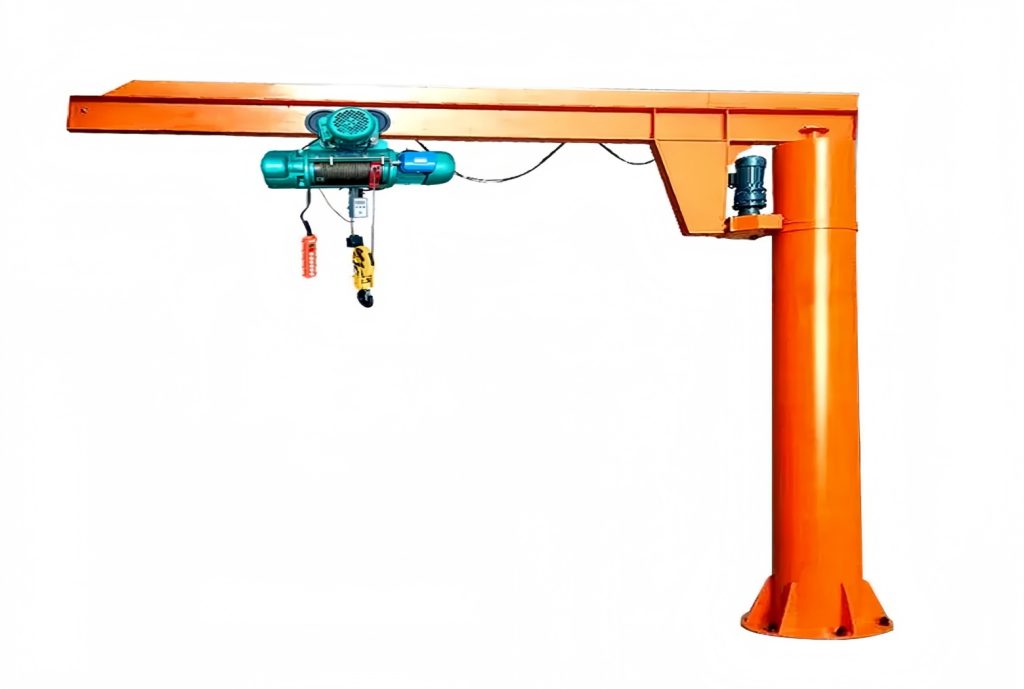
1.1 Jib Crane
Definition: A floor-mounted lifting device consisting of a vertical mast (column), a horizontal jib (boom), and a hoisting unit (e.g., chain hoist). The mast is typically anchored to the floor via a baseplate or connected to the building structure. The jib can be fixed, slewing, or traveling.
Key Features:
- Independent Structure: Self-supported, not reliant on wall strength.
- Large Coverage: The jib provides 180° to 360° rotation, covering a circular or fanshaped work area.
- High Capacity: Designed for loads ranging from a few hundred kilograms to several tons.
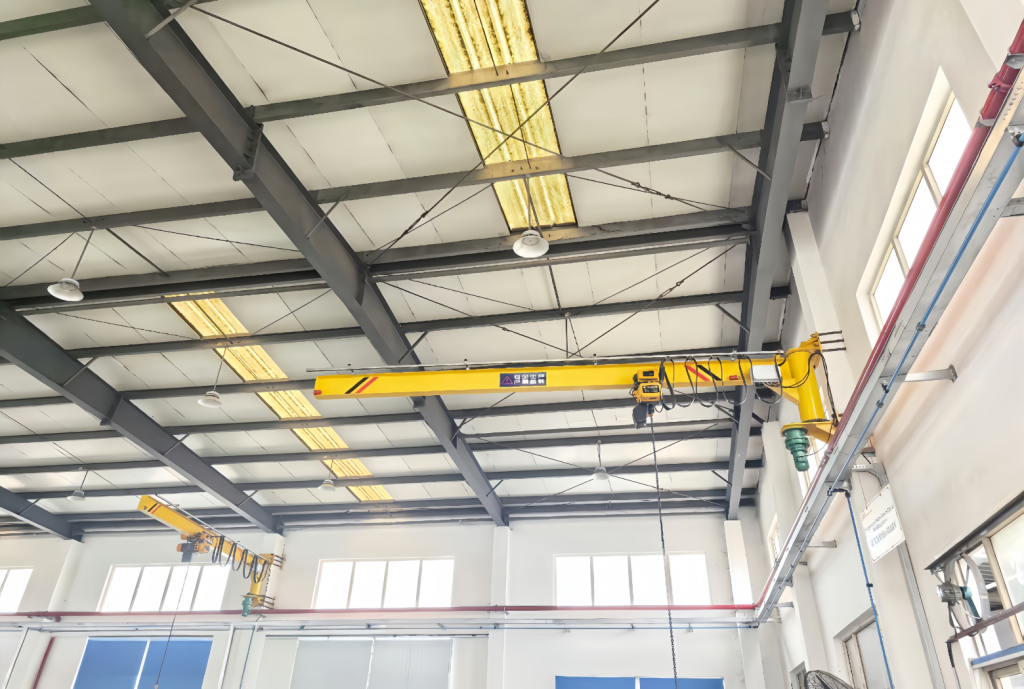
1.2 Wall-Mounted Crane (Wall Jib Crane)
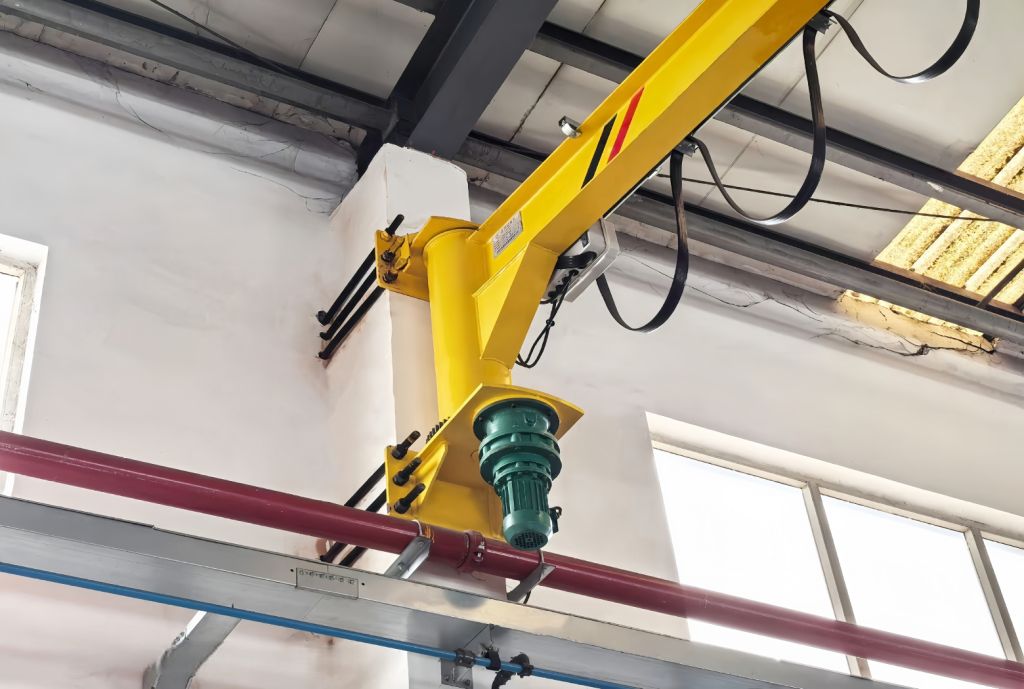
Definition: Also known as a wall pillar jib crane, it consists of a cantilevered boom bracketed to a wall or structural column and a hoisting unit. It uses the existing wall as its primary support.
Key Features:
- Dependent Structure: Relies entirely on the wall’s strength and stability.
- Limited Coverage: Typically provides 180° or less of fanshaped rotation, operating close to the wall.
- Saves Floor Space: Occupies minimal to no floor space, ideal for work areas along walls.
2. Detailed Comparison Analysis
| Aspect | Jib Crane | Wall-Mounted Crane |
|---|---|---|
| Installation | Floor-mounted (foundation or freestanding with counterweight) or tied to a building column. | Directly fixed to a load-bearing wall or sturdy structural column. |
| Space Occupancy | Occupies some floor space (mast base) but provides clear overhead workspace. | Minimal floor space usage, all structure is against the wall. |
| Work Coverage | 360° full rotation (mast-mounted) or 180°-270°, covering a large area. | Typically 180° rotation, covering afanshaped area near the wall. |
| Lifting Capacity | Medium to High. Common range: 0.5T to 5T, with special designs exceeding 10T. | Relatively Lower. Usually 0.25T to 2T, limited by wall strength. |
| Installation Flexibility | Higher. Can be installed almost anywhere on the shop floor, independent of walls. | Lower. Must be attached to a qualified, robust load-bearing structure. |
| Ideal Application | Workstation centers, machine tool loading/unloading, equipment maintenance areas needing full coverage. | Assembly lines along walls, loading docks, warehouse perimeters, narrow aisles. |
| Cost Consideration | Higher initial cost (foundation/structural work) but more versatile. | Generally lower initial cost (no foundation), but requires specific wall conditions. |
3. How to Choose: Key Decision Guide
Step 1: Evaluate Core Needs
- Work Area: Is it an independent workstation center (choose Jib Crane) or a linear area flush against a wall (choose Wall-Mounted Crane)?
- Load Requirement: Is the load over 1-2 tons? If yes, a Jib Crane is usually the safer, more robust choice.
- Space Constraints: Is floor space extremely precious, allowing no columns? If yes, a Wall-Mounted Crane may be the only option.
Step 2: Inspect Site Conditions
- For Jib Cranes, check:
- Can the floor accommodate foundation work or support a counterweight?
- Is there sufficient overhead clearance?
- Is mobility needed? (Consider a traveling jib crane on a runway).
- For Wall-Mounted Cranes, you MUST verify:
- The wall must be a load-bearing wall or a robust concrete column. Professional assessment is needed for drywall/stud walls or old masonry.
- Ensure no hidden utilities (plumbing, electrical) inside the wall.
- Installation height and boom length must prevent collisions with the wall during operation.
Step 3: Consider Long-Term Use & Cost
- Jib Crane: More flexible long-term. Relocation or modification is feasible if workstation layout changes. A common choice for overall plant planning.
- Wall-Mounted Crane: A cost-effective solution for specific peripheral handling needs. Once installed, its location is largely fixed.
4. Typical Application Scenarios
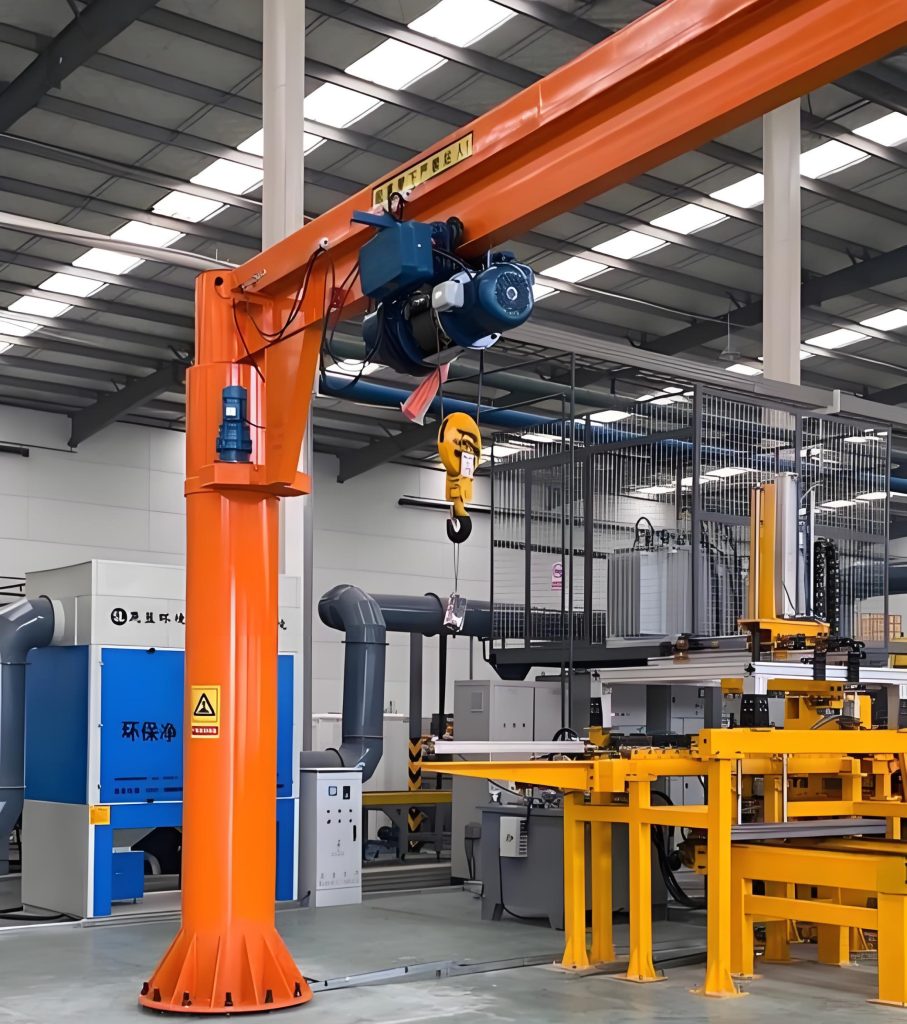
Scenarios Favoring a Jib Crane
- Machine Shops: For 360° rotation loading/unloading of heavy workpieces next to CNC machines.
- Assembly Workstations: For multi-angle component assembly at a dedicated station.
- Maintenance Bays: For disassembling and reassembling large equipment components.
Scenarios Favoring a Wall-Mounted Crane
- End of Packaging Lines: Transferring finished products from the line to pallets stacked along the wall.
- Small Warehouses: Moving materials in the aisle between shelving and the wall.
- Fire Stations or Repair Shops: Mounted along the wall for lifting small engines or heavy tools.
Conclusion and Final Recommendations
Jib Cranes and Wall-Mounted Cranes are not competitors but complements, serving different spatial and operational needs.
- Choose a Jib Crane if you need an “independent work island”. It is the workhorse for material handling in the center of a workspace, offering strong capacity and full-area coverage.
- Choose a Wall-Mounted Crane if you need a “space utilizer”. It is the perfect auxiliary tool for optimizing edge-of-space efficiency, solving wall-adjacent handling needs at the lowest cost and footprint.
Final Advice: For optimal layout, consider using both. Employ Jib Cranes as central workhorses and install Wall-Mounted Cranes along walls as needed. This creates a highly efficient, full coverage material handling system. Always consult with a professional lifting equipment engineer to conduct load-bearing and safety assessments for the installation points.